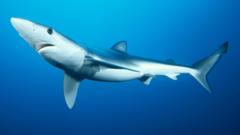

Scientists will use 75 electronic tags to track sharks including the blue shark
ByJulia Gregory
South West
Scientists have been given nearly £1m to study the movement and breeding grounds of three endangered shark species.
Natural England's Species Recovery Programme will focus on the blue shark, porbeagle and tope.
It will use electronic tags to pinpoint migration routes, areas where they live, and how sharks respond to capture and release by anglers.
The team will also work with anglers in hubs including Looe, Falmouth and Brightlingsea, to look at catch records to help build up "the most complete picture yet" of shark distribution.

The team will be monitoring species including the porbeagle shark
Experts will also use ultrasound scanning to identify pregnant sharks and locate potential pupping and nursery grounds.
The team plan to run workshops and structured interviews with at least 45 anglers to pick their brains about the local ecology and size of sharks caught in the past.
Their findings will be used to update England Red List assessments and guidance for anglers to improve survival rates of sharks they release.
University of Exeter marine scientist Dr Matthew Witt said: "Coastal and open ocean sharks are among the most threatened groups of animals, yet they hold huge ecological, cultural and economic value."
Witt added: "By combining generations of angler knowledge with state-of-the-art animal tracking technology, we're building the evidence needed to secure a future for these remarkable species."
The shark project also involves the Angling Trust, the Marine Biological Association (MBA) and the Pat Smith Database.
MBA senior research fellow Dr Bryce Stewart said: "Important and vulnerable shark species live in English waters, yet significant knowledge gaps remain regarding their distribution and abundance."
He said the data they collect will "help us to identify the actions needed to secure their future".
Follow BBC Devon on X, external, Facebook, external and Instagram, external. Send your story ideas to spotlight@bbc.co.uk, external.