Lana LamSydney
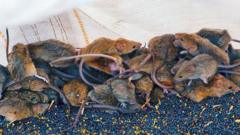
A mouse plague is terrorising farmers across large swathes of Australia, with the rodents running rampant around homes and ravaging fields of grain.
This new battle has seen farmers pour hundreds of thousands of dollars into either re-planting crops that have been devoured by the mice or spending precious farming hours laying down bait – sterile seeds laced with mouse poison.
"It's a big cost and it's not just the price of the bait," says Geoff Cosgrove, 43, who runs a 14,000-hectare farm in Mingenew, Western Australia (WA), growing wheat, canola, lupin and barley.
"They do play with your mind - running around at night, in the ceiling, the air conditioning units. You can hear them and you can smell them - it's like a decaying body."
Cosgrove has been farming for 25 years and in that time, he's only ever had to bait twice. This year's mouse plague is "way worse than the one in 2021", he says.
That year a mouse plague swept through many parts of Australia, with large areas of New South Wales (NSW) and parts of Queensland suffering their worst plague in memory.
The situation was so dire in NSW that hundreds of prisoners were forced to relocate after mice caused extensive damage at their jail.
This time, farmers in WA first began reporting plague-like numbers of mice in March, with their neighbours in South Australia following suit shortly after.

 Geoff Cosgrove
Bumper harvest boosts mice numbers
About two hours north of Cosgrove's farm, agronomist and farmer Belinda Eastough, 59, recalls the mouse plague that hit WA about five years ago.
"The last time [in 2021], they were in my handbag," she says from her 5,500-hectare farm in Nolba, 80km (50 miles) northeast of Geraldton, one of the hardest hit areas.
"They were everywhere - in the floors, the walls, in the pantry. But I haven't had them in the pantry this year."
That's because "they're staying where the food is," she says, out in the paddocks.
"Last year, we had a record-breaking harvest so that gives the mice a lot of food."
A big harvest means large amounts of grain spilt in the paddocks during the processing of crops, leading to an easily accessible and much-loved food source for mice.
"Then we got some summer rain," Eastough says, which spurred the growth of young green shoots.
"So instead of just steak, they got steak and salad. Basically, the mice were in absolute mouse heaven."
 Amy Schultz
Eastough, who's been farming for almost 40 years, grows wheat, canola and lupin with the wheat either exported to South-East Asia for udon noodles or used domestically in biscuits, bread and pasta.
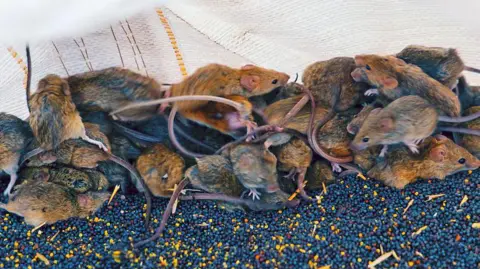
In her canola paddocks, she estimates there are about 8,000 to 10,000 mice per hectare - about the size of a rugby field.
"Sometimes we've had mouse plagues, and the numbers will crash once they run out of food but this year, they haven't.
"I'm living the nightmare."
 Australian Broadcasting Corporation/Chris Lewis
'Another headache'
The autumn months are some of the most crucial for grain growers as that's when they plant their crops.
As an agronomist, Eastough advises farmers on their crops and this year, she's urging them to bait as soon as possible after planting the seeds.
"If the baiter hasn't followed quickly enough behind the seeder, the mice are coming along at night and eating the seed out of the furrows," she says.
"If you finish seeding at 8pm at night and you come in the next day, you'll have rows of crop missing."
Eastough says farmers are very resilient but rising diesel and fertiliser costs have hit them hard since the Iran war broke out in February.
"We're paying twice for fuel now than we were paying two, three months ago," she says.
"The mouse thing is another thing thrown on top, another headache."
 Getty
Getty
'Monumental problem'
Steve Henry, a research officer from Australia's national science agency CSIRO, specialises in mice and how to eradicate them.
Generally, a plague is defined as 800 mice per hectare, he says.
"But in Western Australia, they're talking about thousands and thousands of mice per hectare," says Henry, mainly through the northern and southern cropping zones.
On a recent visit to WA, he counted 30 to 40 active mice burrows when he walked a 100m distance of a one-metre wide strip.
Multiplying that figure by 100 is how farmers estimate mice populations, which means there were at least 3,000 to 4,000 burrows per hectare. In South Australia, the situation was similar.
"That's a monumental problem as this is a really important time for farmers," he says.
Mice can start breeding at just six weeks old, he says, and they can have six to 10 babies every 19 to 21 days.
"The kicker is within two or three days of giving birth, they fall pregnant again so while they're rearing the first litter, they're gestating the second," Henry says.
He also points out the psychological impact of the plague alongside its economic cost, as farmers can't switch off when they finish work for the day.
"If you're dealing with a drought, you can go inside and close the door and turn on the air conditioner and get some level of respite," he says.
"But if you're dealing with mice, you go inside, close the door, go to your cupboard, and the mice are in the cupboard ...
"You go to sleep at night, and the mice are running across your bed."
Winter, rain and stronger bait may quell plague
 Australian Broadcasting Corporation/Chris Lewis
For months, farmers have been desperate to get access to a stronger bait but they had to wait for permission from the national regulator.
In recent days, that approval was granted and the higher strength bait is now available to farmers.
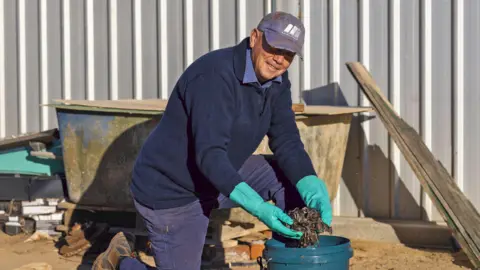
Retired farmer Damian Ryan, 67, has welcomed the move after spending weeks catching mice in his home and his shed at his farm in Morawa, about 370km north of Perth.
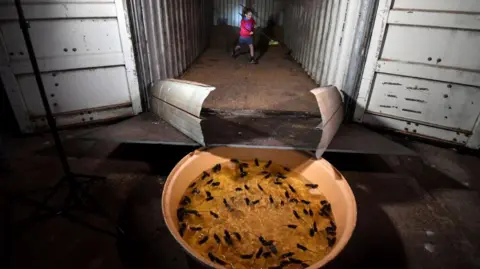
He says he's been catching 20 to 30 mice in his house and about 150 in his shed each day.
In his 50 years of toiling the land, dealing with the odd mouse is normal, but "I've never seen it this bad, ever".
"These things were like plague proportions. You drive around at night and you just see mice running everywhere."
With cooler temperatures, rain forecast and the stronger bait, farmers have reported a drop in mouse numbers in recent days.
Cosgrove is hopeful that with winter around the corner, relief is on the way: "Eventually they do stop 'cause it gets too cold and wet."