Aleks Phillips

 Getty Images
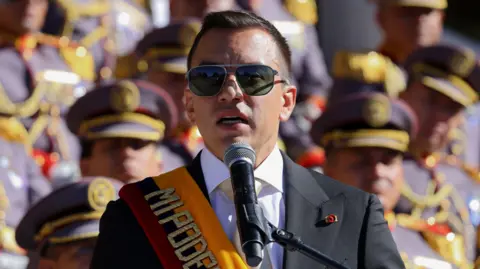
Colombia's foreign ministry has accused Ecuador's president of "deliberate interference" in its forthcoming election after he promised a right-wing candidate he would lift tariffs.
Daniel Noboa framed his conversation with Colombian presidential hopeful Abelardo de la Espriella on Friday as one with an administration-in-waiting, saying the two had "reached an agreement" on trade and security.
Colombia heads to the polls on Sunday to elect a new president, in an atmosphere of intense political polarisation.
The outcome of the election could redefine which countries the Latin American nation aligns itself with, and how the government intends to tackle drug gangs amid spiralling violence.
Left-wing President Gustavo Petro, who is unable to seek re-election, has repeatedly sparred with US counterpart Donald Trump over a number of issues including drug trafficking and American intervention in the region.
Noboa, a staunch ally of the US president, has taken a hard line on drug-related violence and has joined a US-led alliance aimed at fighting cartels.
He wrote that he had decided to drop Ecuador's tariffs on Colombian products as of 1 June following his conversation with de la Espriella, and said the two had "agreed on the handover of Ecuadorian criminals who are in Colombian territory".
Ecuador has gradually imposed tariffs on imports from Colombia since January, citing what it described as Colombia's failure to secure their shared border.
Its geographical location - sandwiched between Colombia and Peru, the world's largest producers of cocaine - has turned Ecuador into a key transit country for the illicit drug.
Petro's government has denied the accusation and responded with economic measures of its own.
Colombia's foreign ministry criticised "the misleading presentation of the decision to repeal the tariffs as a goodwill measure by the Ecuadorian leader" in a statement on Saturday.
"This meddling by a foreign leader in the democratic process of another state constitutes a flagrant violation of the principle of non-intervention in internal affairs, a threat to national sovereignty and an attack on the democratic system," it added.
Colombia's political culture had for decades often favoured the election of centrist technocrats to the presidency.
But its politics has become increasingly polarised, with Petro becoming Colombia's first left-wing president in its recent history.
None of the candidates in Sunday's poll appear likely to win an outright majority, with a run-off vote scheduled for 21 June.
Polling suggests Petro's choice of successor, Iván Cepeda, has the greatest support, with de la Espriella his next-closest rival.
Cepeda has promised to continue with the Petro administration's policy of "total peace", which sought negotiated settlements with armed insurgent groups that engage in drug trafficking - though talks have stalled and agreements broken with renewed violence.
De la Espriella and centre-right candidate Paloma Valencia have vowed to launch a military crackdown if elected.
 Getty Images
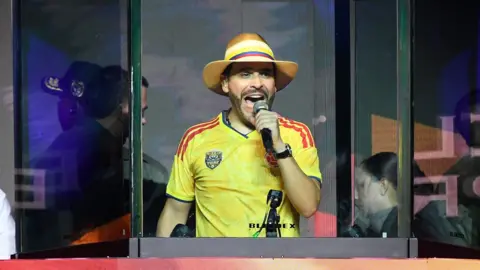
Colombia's presidential hopefuls have campaigned amid persistent political violence, with one candidate fatally shot last summer. Last week, de la Espriella appeared at a rally in Medellin behind bulletproof glass.
He and Valencia have expressed a desire to restore Colombia's close security alliance with the US, which has come under strain under Petro and Trump.
Cepeda has insisted, just as Petro did, that Colombia should not be a "vassal state" to the US - though observers have noted that the two nations' historic anti-drugs co-operation has continued during even the most heated disputes.
The capture by US forces of Venezuela's former President Nicolás Maduro in January has left Petro one of the region's few remaining left-wing leaders not ideologically aligned with the Trump administration.
However, Trump has since turned his attention to Cuba and has openly discussed toppling the Communist regime there, which he has described as "ready to fall".