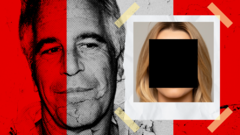
In the week after the sex-criminal financier Jeffrey Epstein died, Anya (not her real name) opened the door of her New York apartment. Outside was Epstein's brother, Mark, telling her she had to leave, she says.
Anya had lived for years in one of several flats on East 66th Street in Manhattan used by Jeffrey Epstein to house women he abused. In one moment, she lost her home but escaped a nightmare. (Mark Epstein denies he was aware of his brother's wrongdoing.)
"I'm still struggling to reconcile with the fact that I was abused for years," Anya says. "You were not chained to a door or something, right? You were not locked up in a basement. The chains were less obvious, but they were there."
Epstein, who died in 2019 while awaiting charges for sex-trafficking children, used to say that his operation was "like a cult, and he was the cult leader", Anya says.
She has given the BBC a rare account of life as one of Epstein's "assistants", detailing how the financier maintained a hold over so many of his victims for so long.
The assistants were a group of women - roughly a dozen at one time, Anya estimates - who were housed by Epstein, worked all hours at his beck and call, and were regularly sexually abused by him.
Anya says they were drawn in with elaborate deceptions and empty promises of work, before he began to coercively control nearly every aspect of their lives, exploiting any weaknesses he could uncover.
She says he controlled their finances, dictated who they saw and psychologically demeaned them. He monitored their bodies obsessively, Anya says, and forced her to have unnecessary, disfiguring surgery.
Her account of Epstein's control is echoed by Sarah Kellen, another former assistant. She told the US House Oversight Committee earlier this year how Epstein presented himself as the assistants' saviour. "He was very good at just decimating your ability to make your own decisions and have your own autonomy. And it made you more and more dependent on him," she said.
There is a bias which tends to make people think that only children are susceptible to this type of coercion, but "you can be groomed as an adult", says Dr Tara Quinn-Cirillo, a clinical psychologist who has worked with victims of coercive control. "You can be vulnerable to this," she says.
After Jeffrey Epstein was convicted in 2008 of abusing a teenage girl - whom he lured to his homes with the offer of work as a masseuse - he changed tactics. He began largely targeting adult women, mostly from Russia or other parts of eastern Europe.
Anya says she and many of the other women recruited still looked like teenagers, however, and she showed the BBC photos of herself at the time to demonstrate.
Anya had grown up in a Russia emerging from communist rule, with strict parents who drilled into her that "education will be your success", she says. But opportunity was scarce and, armed with her degree, she left Russia to work as a model.
She worked in Europe for luxury brands such as Fendi and Chanel. She had friends, a support system and family she could fly back to see whenever she wanted.
In her early twenties, she came into Epstein's orbit when she visited a Paris agency and met modelling scout Daniel Siad. He complimented her intelligence, "which is not typical in the modelling industry", Anya says, and suggested introducing her to a friend of his with connections in the fashion business: Epstein.
Anya says she used to wonder what would have happened if she had not stopped by the agency that day, but now she believes she was purposefully targeted. "It was a complete set-up," she says, describing Siad as "essentially a professional trafficker".
Siad's name appears thousands of times in the Epstein files - the massive collection of documents about the financier released by the US government in January. Siad's lawyer said he was not available for comment, but he has previously denied any knowledge of the threat that Epstein posed.
Anya says she first met Epstein at his sprawling 18-room Paris apartment, decorated with pictures of himself posing with people such as Bill Clinton and other world leaders. She says she felt comfortable because there were two other women present, one Russian and the other Epstein's then-girlfriend from eastern Europe.
Epstein asked Anya to undress so he could see her body for modelling, she says. As she stood in her underwear, she says the financier told her she was "not in shape" and needed to "start working out", calling her lazy.
Comments such as these were common in the modelling industry, Anya says, and she believed his claims that if she worked hard, he would introduce her to the right people.
Anya says he asked her about her family, her interests, "what I was trying to accomplish in life, why I was doing modelling, all things that mattered for me".
"You don't get asked those questions in fashion," she says. Several women have told the BBC that Epstein liked to learn what mattered to them so that he could later use the information against them.
He also addressed her concerns head-on. "I see that you're smart and you're suspicious," she recalls him telling her. "I don't want to sleep with you."
Anya says this put her even more at ease. "I was telling myself, gosh, this guy is just incredible. He can see right through me," she says.
This was just the start of a grooming process that would unfold over many months, stringing Anya along with empty promises and an extended deception.
Over the course of almost a year, Anya began exercising "religiously" to get the body Epstein wanted, she says. Lesley Groff - his executive assistant who managed his diary - would email for updates on her progress and Epstein pressured Anya for pictures, telling her not to be "shy" when he insisted on nudes.
Epstein eventually arranged a meeting between her and the co-founder of model agency Next Management, Faith Kates, as he had promised, Anya says. She says it lasted less than 30 minutes and Anya was told Epstein would let her know the outcome.
The financier told her that Next did not want to hire her because she "wasn't good enough for the New York market", Anya says, with Epstein adding that she was "out of shape".
Anya says she was dejected. Epstein told her to visit him in Palm Beach, Florida, where he was on day-release while he served his sentence. He had blamed his conviction on a girl deceiving him with fake ID, she says.
Anya had to sign a register kept by a uniformed police officer to see him. Epstein escorted her into a back room, where he sexually assaulted her for the first time. At least two other women have said he sexually assaulted them while serving his sentence.
After the assault, Epstein ushered her out of the back room and started joking with the other assistants waiting outside that Anya was "so shy". They all laughed at her, she says, and their reaction made her blame herself.
"I thought maybe nothing wrong really happened here. Maybe it's just my reaction that is wrong," she says. "Maybe it's my Russian upbringing, maybe it's how strict my parents were, but there's something off with me and not with him."
It was only when the Epstein files were released that Anya says she realised what had really happened. Emails showed that despite her face-to-face meeting with Faith Kates, the agency founder had in fact rejected her a year earlier.
Anya says she realised she had been strung along for months by Epstein and set up to fail, in "a very elaborate grooming". Then, when she was vulnerable, isolated and far from home, Epstein had struck.
The type of slow, steady grooming Anya describes is designed to avoid triggering the target's sense of danger, "like stealth bombers are designed just to go under the radar", says the psychologist Quinn-Cirillo.
Faith Kates' lawyer told us in a statement that any claim her client had any knowledge or involvement in Epstein's purported trafficking is false and defamatory. Suggesting Epstein would relay the agency's decision to Anya was "unusual… false and uncorroborated," the lawyer added.
The agency made its own decisions about which models to take on, and did not seek Epstein's approval for such decisions, the statement continued, adding: "Obviously, there is nothing unusual about a potential model being considered and rejected from a modelling agency, even more than once."
Next Management said in a statement that the company had no relationship with Epstein and Kates' alleged actions had been "hers alone".
But work as Epstein's assistant was not what Anya imagined. She says Epstein taught her nothing about business.
Instead, she says she would largely sit around waiting for Epstein to give her something to do, while Epstein berated her for sitting around doing nothing. Sometimes he would give her menial tasks to do: answer the phone, show someone to a meeting room, or announce a guest.
Nevertheless, the assistants were on call 24/7, Anya says. One time, Anya says she popped out for lunch to meet someone and Epstein "went crazy", repeatedly calling her and insisting that she could never leave the house without his permission.
Anya was completely dependent on Epstein. If she got sick and needed healthcare, she says he would tell her: "I'm your medical insurance." She did not have a bank account or the correct documentation to rent her own home, but she says Epstein kicked her out of the Manhattan apartment a few times, telling her to "figure out where you are staying". These were strong mechanisms of control, she says.
If you've been affected by any of the issues in this story such as sexual abuse and violence, information and support is available at BBC Action Line
Epstein only started paying Anya a small salary years later because her visa required it, she says. He would often say, "don't worry, I'll always support you". The sexual abuse continued frequently throughout this period, Anya says.
Sarah Kellen painted a similar picture to US lawmakers: "I had no money, no family, no education, and no sense that I deserved any better." Meanwhile, Epstein showed off his power and connections to her. "Jeffrey made certain I knew that defying him would cost me my life," she says.
On one occasion, an assistant ran away, Anya recalls. Anya says the woman had called her during her escape, leaving Anya fearful that Epstein would find out they had been in contact, as he owned their phones and monitored their calls.
Epstein hired a private investigator to trace the missing assistant, Anya says. She says he showed her an email detailing the expenses he calculated the missing woman owed him, a total of $700,000 (£521,000). Anya says she got the message loud and clear: if you leave, you will owe me money and I will hunt you down to get it back.
This was not the only thing Epstein held over the women. He also gathered compromising material, Anya says, and he would casually remind her that he had naked pictures of her.
On one occasion, she says, he gathered his assistants for a photoshoot. Epstein encouraged them to go topless and dance joyfully, insisting it was filmed. Anya recalls he said "this way I know you'll never go against me", suggesting that it would be hard for them to argue they were not consenting if he showed the video. "That's his library of evidence," she says.
The financier also made his assistants write him emails which they called "gratitude letters", gushingly thanking their abuser. "I was so terrified of not saying 'thank you' enough to him," Anya says.
"I think partially maybe those gratitude letters were another mechanism of him saying, how can you go against me if you are thanking me all the time?"
Epstein would also pit the assistants against each other, Anya says. He would let slip that another woman was "mad" at her for being "useless and so lazy", but he would say he was "advocating for you" as "your biggest supporter", she says. In this way, he prevented the women from forming real relationships with each other, making them easier to control.
As Anya talks to us, she lifts up her top to reveal several scars across her stomach. Then she shows us old modelling photos where she had a small tattoo, dating back to when she was a teenager.
Epstein wanted her to remove it and a doctor came to his house, she recalls. But he did not want her to have laser treatment because it would take too long, so he suggested the doctor cut the tattooed skin off. "Only I could come up with that," she recalls him saying.
She says she had the surgery, which left scars. A year later, he insisted that it was done again because he did not like the results.
The "most shameful" part of her time with Epstein was having to recruit other women, Anya says, her eyes welling up with tears.
Each assistant had to bring in at least one other assistant, she says, and Epstein told them to recruit young women like her.
"It's one or 10, like, you're already complicit."
Anya says she wanted to speak out now to help people understand how women became trapped by Epstein and to explain how his operation had trafficked adults like her as well as children.
"He built this whole ecosystem of abuse that was serving him," she says. "When you have people like Bill Gates come to his house for dinner and shake his hand, you think, who am I to question it? Who am I to speak up here? It legitimised the abuse."
Both Anya and Sarah Kellen have subsequently received compensation from the Epstein Victims' Compensation Fund, which was established to provide financial relief to survivors and involved sharing corroborating evidence of their abuse.
"When he was alive, I didn't speak to a single person about this," Anya says. She now hopes that her voice can help just one woman escape an abusive relationship.
"I'm not in any way special," she says. "I just somehow managed to find this strength in me to persevere and to survive. If I can do it, you can do it."
If you have information about this story that you would like to share, please email epsteininvestigation@bbc.co.uk, external