Abdujalil AbdurasulovIn Warsaw

 Reuters
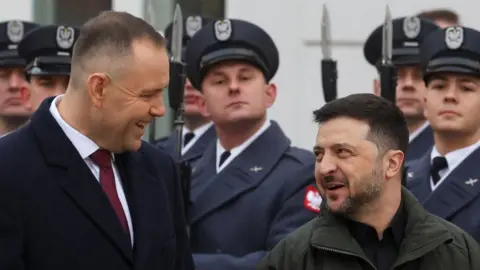
Ukraine is facing a major diplomatic fallout with key ally Poland, after Kyiv decided decision to name a military unit after controversial World War Two fighters, reopening a painful chapter from the past.
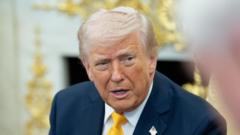
Polish President Karol Nawrocki is considering stripping Ukraine's Volodymyr Zelensky of the country's highest state honour, the Order of the White Eagle.
Nawrocki has already consulted with the council of the order and says he will decide whether to revoke the honour "in due course".
The spat began when Zelensky issued a decree late last month naming a military unit of the Special Operations Forces after the Ukrainian Insurgent Army (UPA), which existed in the 1940s and 1950s.
Many in Ukraine regard the UPA's members as heroes who fought for Ukrainian independence against the Soviet Red Army as well as Nazi Germany and Polish authorities. So for Ukrainians the title "Heroes of the Ukrainian Insurgent Army" is a major honour.
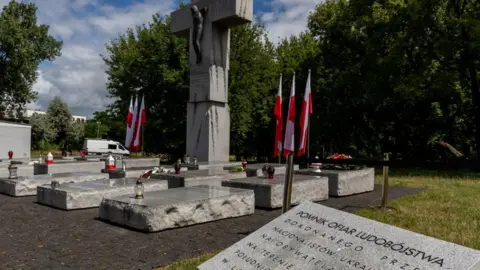
Poland, however, accuses UPA of carrying out a genocide of ethnic Poles in Volhynia (now Volyn in Ukraine) in 1943-45. Zelensky's decree caused significant outrage in Poland, and Nawrocki condemned it as "glorification of bandits and killers".
There has been criticism from across the political spectrum – from far-right to left-wing groups.
 Getty Images
Many felt Ukraine was ungrateful to Poland, which opened its borders to millions of Ukrainians fleeing the full-scale Russian invasion, and continues to provide shelter to almost a million refugees.
Some MPs from the opposition Law and Justice (PiS) have called for "a drastic reassessment of relations" with Kyiv.
The leader of the far-right Confederation party, Krzysztof Bosak, has demanded that Warsaw stop funding the Starlink satellite services that Ukraine's army has come to rely on, as well as blocking Ukraine's accession to the EU until Kyiv reverses its decision.
Nawrocki himself said Zelensky's decision showed that "Ukraine is not ready to join the European family".
Even politicians regarded as "pro-Ukrainian" have strongly condemned Zelensky's controversial decree.
Prime Minister Donald Tusk has urged Kyiv to look for solutions: "If not, it will mean that not empathy but hard business will determine our relations."
For Ukraine, the UPA is a symbol of resistance and struggle for independence, even though Warsaw says about 100,000 ethnic Poles were killed in the Volhynia massacres.
The group's red and black flag is often used by Ukrainian troops on the front line today. That's why, in his decree, Zelensky said he was using the UPA's name "with the aim of restoring the historical traditions of the national army".
Kyiv has not officially responded to the criticism from Poland, although the foreign ministry has stressed it had no intention to cause offence.
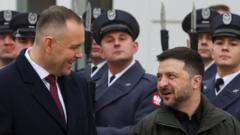
But Zelensky's chief of staff, Kyrylo Budanov, travelled to Warsaw last weekend following Nawrocki's threat to strip the Ukrainian president of the Order of the White Eagle.
 NurPhoto via Getty Images
Budanov's mission was to ease tensions and end the crisis, but it appears his trip failed as after his visit Nawrocki gathered the council of the Order to discuss this issue further. Even Tusk later admitted that "diplomacy has yielded no results".
The Ukrainian leader, who usually makes foreign trips from the Polish airport of Rzeszów chose this week to fly to the UK via Moldova.
Tusk has made clear that the airport is not closed to Zelensky: "I am not going to tell him where and how to fly."
However, analysts worry that stripping Zelensky of the order may lead to a major diplomatic rupture that can have serious repercussions for both countries.
Discontent among the Poles already threatens to overshadow an upcoming conference on Ukraine's post-war reconstruction scheduled later this month in the northern Polish city of Gdansk. Poland's foreign minister has indicated Zelensky may choose not to attend.
The tensions could also strengthen parties on the right that have been critical of support for Ukraine, observers believe.
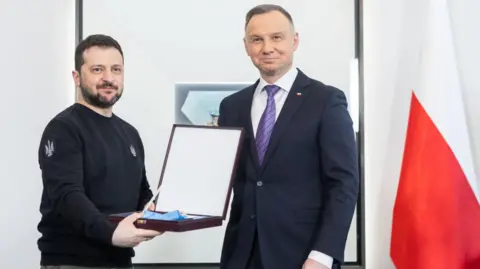
The Polish Order of the White Eagle bestowed on Zelensky in 2023 by then President Andrzej Duda can be revoked if he is deemed to have "committed an act making them unworthy" of the honour.
However, commentators suggest such a move may require the support of Prime Minister Donald Tusk.
And Tusk is seeking to dampen the spat, appealing to both Zelensky and Nawrocki to have "a direct and honest conversation" before things spiral out of hand.
"Co-operation serves the interest of both our states and nations, while conflict serves Moscow's interests", he said.