NEWYou can now listen to Fox News articles!
This summer, millions of Americans will head to the airport, ready for long-awaited vacations, family visits and once-in-a-lifetime adventures. They will pack their bags, shuffle through airport security lines and make their way through crowded terminals. On board, they’ll buckle their seat belts, hear the safety briefing and settle in for the flight ahead. Throughout it all, they will trust that every layer of the aviation system is working as it should.
That trust is well-placed. The U.S. aviation system remains the safest in the world because it is built upon layers of protection: highly skilled pilots, rigorous training, strong standards and coordination that helps crews identify risks before they become emergencies. Today, those layers are under growing pressure. More traffic, more complexity and aging infrastructure. Recently identified gaps in safety technology are also narrowing the margin for error.
Most passengers never see the full spectrum of the U.S. air safety system at work. As pilots, we see it every day. We have a responsibility to prioritize the safety of every flight and the authority to delay, cancel, abort or divert when necessary. We are trained to gather the full picture before takeoff — weather, fuel, alternate airports — and to keep evaluating risk until the aircraft is safely parked at the gate. It is a duty we take seriously. That’s why we cannot stand by when the aviation system is sending clear warning signs.
Over the past 15 months, the signs of strain have become impossible to ignore. A fatal midair collision near Washington National Airport. A deadly runway collision at LaGuardia. A growing list of near misses. An aging air traffic control system. Persistent controller staffing shortages. Each is concerning on its own. Together, they point to a system that’s being stretched thin.
'WARNING SIGNS WERE ALL THERE' BEFORE DEADLY DC MID-AIR CRASH, FORMER AIR TRAFFIC CONTROLLER SAYS
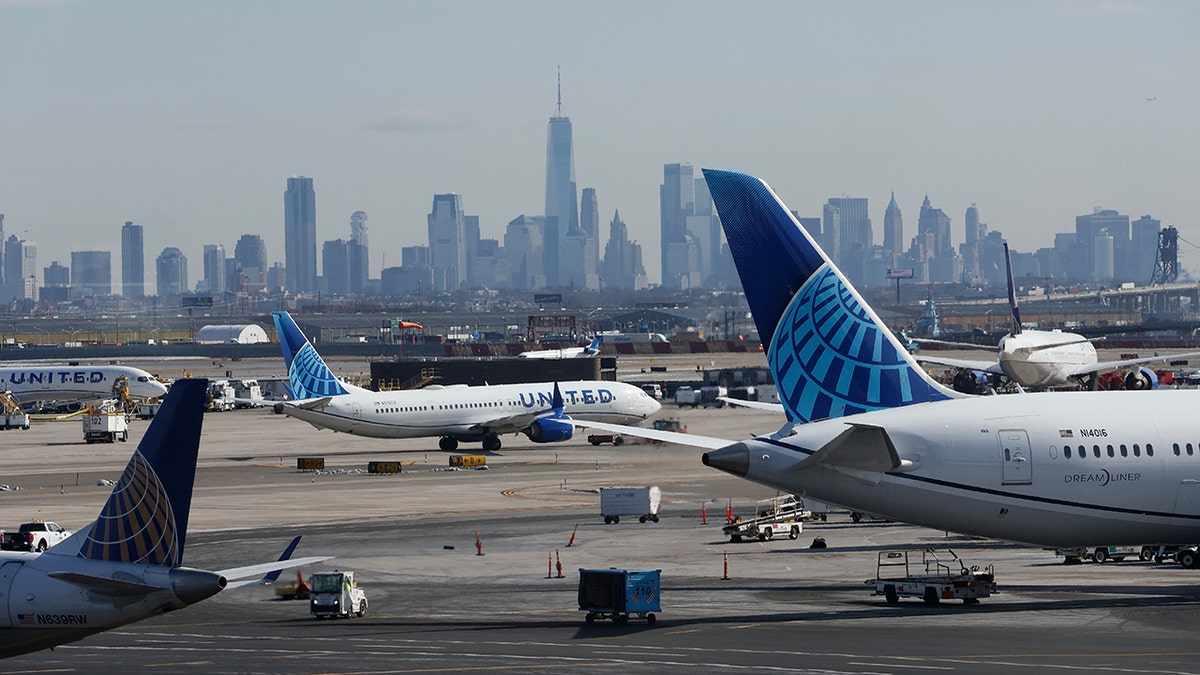
United Airlines airplanes sit parked at gates while others proceed to a runway at Newark Liberty International Airport in front of the skyline of lower Manhattan and One World Trade Center in New York City on February 20, 2025, in Newark, New Jersey. (Gary Hershorn/Getty Images)
Reducing this risk requires sustained investment in the technology, infrastructure and people who keep the system moving safely. That means modernizing air traffic control systems, replacing outdated equipment and ensuring there are enough fully trained controllers. Congress made an important down payment on air traffic control modernization last year, but the work cannot stop there. The system needs sustained, long-term funding to keep pace with increasingly crowded airspace.
Strengthening the system also means equipping pilots with the latest technology on the flight deck. The House-passed ALERT Act takes important steps in response to the 2025 crash near Washington National Airport, but it does not go far enough to close the safety gaps it exposed. Chief among them is the need for a simple, commonsense standard: All aircraft operating in the busiest and most complex airspace in the country should be required to use the same real-time tracking and alerting technology to prevent collisions.
Today, commercial aircraft flying near major U.S. airports are generally required to use ADS-B Out, which broadcasts real-time information about a plane’s location, altitude, speed and direction. But ADS-B In — the technology that receives that information and displays nearby aircraft for pilots on flight deck screens — is still not required. It’s a problem that is only compounded when military and other government aircraft operating in busy civilian airspace aren’t required to transmit the same data as commercial airliners.
FOOTAGE SHOWS MOMENTS BEFORE FRONTIER AIRLINES JET STRUCK PERSON ON DENVER AIRPORT RUNWAY
That’s why any final aviation safety bill must require a full, integrated ADS-B In safety suite. Pilots need more than the ALERT Act’s narrow update to the existing collision avoidance system, especially one that would provide limited capability at low altitudes and wouldn’t work on runways and taxiways.
A full ADS-B In suite, as required in the Senate-passed ROTOR Act, would give pilots a clearer picture of nearby aircraft in the air and on the airport surface, along with early visual and audible alerts when the system determines that another aircraft may pose a collision risk.
This added time can help pilots spot the aircraft sooner and decide if evasive action is needed. Coupled with fewer exemptions for military and government aircraft and a firmer deadline for mandating use, the ROTOR Act would help prevent a tragedy like the fatal midair collision in Washington from ever happening again.
CLICK HERE FOR MORE FOX NEWS OPINION
When proven technology is available today and the consequences are too great to ignore, Congress should not settle for a partial fix to this recently identified gap.
Reducing this risk requires sustained investment in the technology, infrastructure and people who keep the system moving safely.
Every pilot is trained to pay attention to warning lights, but a warning does not mean disaster is inevitable. It means something needs attention before the situation escalates. That is where our aviation system is today. Flying remains safe, but recent accidents, near misses and technology gaps have made clear that the system passengers and shippers rely on is under strain.
CLICK HERE TO DOWNLOAD THE FOX NEWS APP
As summer travel surges, Congress has an opportunity to strengthen the layers of safety that protect millions of passengers. It should start by listening to the people who see the pressure building inside that system every day: pilots.
Lawmakers shouldn’t choose between ROTOR and ALERT — they should pass the best of both.
Capt. Jason Ambrosi is the 12th president of the Air Line Pilots Association, International, the world’s largest airline pilot union representing more than 80,000 airline pilots in the United States and Canada.