James Gregory

 Reuters
China has called the US naval blockade of Iranian ports "irresponsible and dangerous".
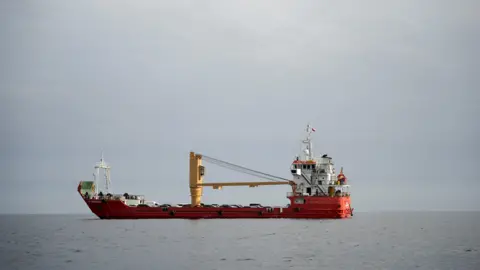
Beijing's foreign ministry said the move would "undermine the already fragile ceasefire agreement" and further jeopardise the safety of ships passing through the Strait of Hormuz, a critical waterway Iran effectively closed in response to US-Israeli strikes.
The blockade came into force on Monday, a day after peace talks between the US and Iran broke down in Pakistan.
US President Donald Trump said the measure is intended to force Iran to give up its nuclear ambitions. Analysts say the move is also designed to pressure China - the biggest buyer of Iranian oil - to encourage Tehran to open the strait.
Iran's ambassador to the UN has described the US blockade as a "grave violation" of Tehran's sovereignty.
Up until now, Chinese vessels have been among the few managing to make their way through the strait. It is not clear whether they had to pay a toll to Iran in order to do so.
The US blockade could potentially cut off China's supply and have far-reaching consequences for its economy.
"China believes that only by achieving a comprehensive ceasefire and ending the war can we fundamentally create conditions for easing the situation in the strait," China's foreign ministry spokesman Guo Jiakun said.
"China urges all parties to abide by the ceasefire arrangements, focus on the general direction of dialogue and peace talks, take practical actions to promote the easing of the regional situation, and restore normal traffic in the strait as soon as possible."
Guo also told a news conference on Tuesday that reports China was preparing to deliver new air defence systems to Iran were "completely fabricated".
Trump has threatened to impose a 50% tariff on China's goods if military assistance was provided to Tehran.
"If the US insists on using this as an excuse to impose additional tariffs on China, China will definitely take resolute countermeasures," Guo said.
It comes after US Vice-President JD Vance accused Iran of "economic terrorism" over its own blockade of the Strait of Hormuz - having attacked, and threatened to attack, vessels passing through since last month.
"Well, as the president of the United States showed, two can play at that game," he told Fox News.
"If the Iranians are going to try to engage in economic terrorism, we're going to abide by the simple principle that no Iranian ships are getting out, either."
The US has said its military would not impede ships using the strait to go to and from non-Iranian ports.
It is instead aiming to blockade Iran's Gulf ports by operating its navy in the Gulf of Oman and the Indian Ocean, rather than risk its vessels close to Iran's coast.
Meanwhile, oil prices fell back below $100 per barrel on Tuesday.
A delicate and fragile ceasefire between the US and Iran remains in place, having been implemented on 8 April.
Major points of contention between the two sides include the status of the Strait of Hormuz, and whether Lebanon is included in the agreement.
Israel maintains that the truce applies only to Iran and has continued heavy strikes against Hezbollah, killing hundreds. Direct talks between Lebanese and Israeli officials are set to be held in the US later - the first such negotiations in decades.