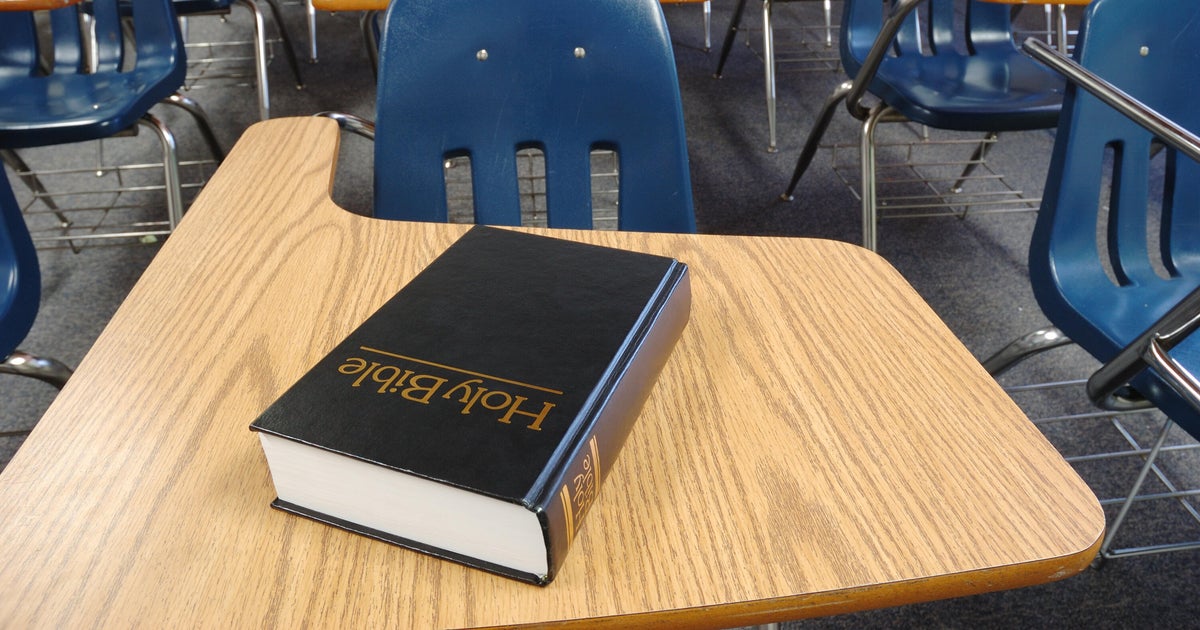
Texas public schools will require students to read Bible stories under a reading list approved by the state's education board Friday, widening conservative efforts to bring more Christian teachings into U.S. classrooms.
The Texas State Board of Education, which is controlled by Republicans, approved the list of over critics who argued the titles lacked diversity and and blurs the separation of church and state.
Under the mandate, more than 5 million public school students in Texas must read traditional literary works such as E.B. White's "Charlotte's Web" and Charles Dickens' "Great Expectations." They'll also be required to read Bible stories, including passages from the New Testament and excerpts from the Book of Job. The rollout will be staggered, starting with elementary school students in 2030.
For months, critics have blasted both the push to require Bible readings and the state mandating what books are read by students, which are decisions typically left up to teachers. Teachers could still assign students other books to read on top of the required titles.
Supporters say Judeo-Christian traditions were fundamental to the nation's founding and that should be reflected in the public school curriculum.
Texas, which educates roughly 1 in 10 of the nation's public school students, has been at the forefront of a charge by conservatives to incorporate more religion into classrooms. The state already allows public schools to hire chaplains to counsel students, mandates the display of the Ten Commandments in classrooms and has approved an optional Bible-infused curriculum.
A focus on Christianity
Critics say the reading list lacks diversity, blurs the separation of church and state that is enshrined in the Constitution and leaves teachers and students with little room to decide what to read.
"Kids of all faith backgrounds and no faith are served by Texas schools and they should all feel welcome in Texas schools," said Elva Mendoza, legislative communications associate for the progressive Texas Freedom Network. "But this is sending the message to children that one and only one religious text — a Christian one — is worthy of making this required reading list."
Others have applauded the possibility of mandated Christian religious reading in public schools. Brooke Mazel, a retiree from Lubbock, encouraged the board to adopt biblical materials, saying her children and grandchildren grew up with "strong faith and family values."
"America should celebrate our 250 years that started as a nation of unwavering Christian values," Mazel said.
The board is also set to vote Friday on a social studies curriculum that links Bible stories with American history.
Texas may be a trailblazer
A state law passed in 2023 required a mandatory list of at least one literary work be taught in each grade level. The proposed new list contains around 200 texts, including Bible passages, essays and books, far in excess of that requirement.
Antero Garcia, president of the National Council of Teachers of English and a Stanford University professor, said he doesn't know of any other state with a mandatory reading list that includes religious texts. Educators at the district and school level usually choose the texts their students will read, Garcia said.
Kasey Meehan, director of PEN America's Freedom to Read program, agrees the move is "unique" to Texas.
Picture-book stories for elementary students, including "David and Goliath" and "Daniel and the Lion's Den," are on the required reading list. By fourth grade, students would encounter passages about Jesus in the New Testament.
By middle school, students would be expected to read several passages about Jesus, including passages from his most famous sermon, and another where he instructs people to cast aside earthly anxiety and seek the kingdom of God.
For high schoolers, the list requires the reading of specific Bible passages as supportive materials for literary works, including works by Dickens and Jane Austen's "Pride and Prejudice."
Holding diversity in check
Such strict requirements amount to "almost de facto censorship," Meehan said, comparing the list to book bans.
"It certainly leans ideologically more conservative," she said. "It excludes a lot of diverse voices from the reading list."
The list mandates that students reading Shakespeare's "The Tragedy of Julius Caesar" also read a eulogy for President Ronald Reagan written by former British Prime Minister Margaret Thatcher, a staunch conservative.
Frank Strong, an English and journalism teacher and co-founder of the student advocacy group Texas Freedom to Read, said diversity is not only important for students needing to see themselves in what they read but also as a way to learn about different cultures.
Many of the books on the reading list are not controversial, but Mendoza asks why books like "Chicka Chicka Boom Boom" need to be required for kindergartners.
"Can't our kindergarten teachers be trusted to choose board books?" Mendoza asks.
In: