Survival before safety for Delhi's poor as temperatures hit 45C
Nikita YadavDelhi

 BBC
BBC
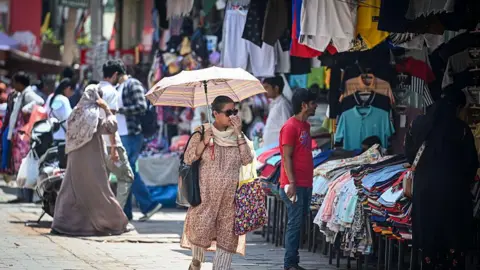
On a scorching afternoon in one of Delhi's busiest markets, two different worlds exist side by side.
One is inside brightly-lit, air-conditioned showrooms, where customers move slowly between racks of clothes, escaping the worst of the summer heat.
The other is outside, under a blazing sun - where street vendors, fruit sellers, cycle-rickshaw drivers and ice-cream cart operators continue working through temperatures soaring above 40C.
In the afternoon, even walking through the market feels exhausting. But for millions of informal workers across Delhi, staying out of the heat isn't an option.
Nearly 90% of India's workforce is informal - most without contracts or job security, many dependent on outdoor work for daily wages.
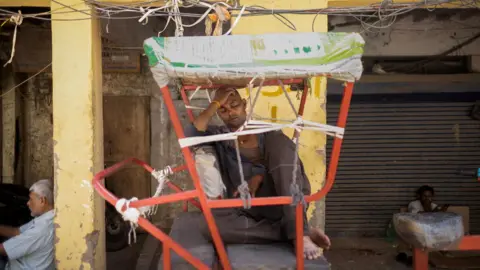
Among them is 52-year-old Harish Chandra, who pedals a cycle-rickshaw through Delhi's crowded streets until the heat becomes too much to bear.
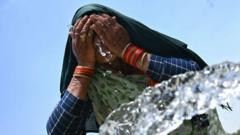
At a public tap, he splashes water over his face before settling into a narrow strip of shade near the market.
"The body gives up," he says.
Dressed in thin, worn cotton clothes, Chandra says Delhi's summers have become harder to bear with each passing year.
"My day starts around nine in the morning, when the weather is still manageable. But by noon, it becomes difficult. The sun is so harsh that sometimes I feel my body giving up while I pedal," he says.
"But if we stop, we don't earn," says Chandra. "And if we don't earn, the family doesn't eat."
He recently sent his wife and three children back to their village in Bihar state. The temperatures there are equally high, he says, but open spaces and better ventilation make it easier to cope than Delhi's cramped neighbourhoods and congested lanes.
For workers like Chandra, who spend most of their time outdoors, summer is no longer just a season, but an annual struggle for survival.
India's heat season typically lasts from April until early July, before the monsoon brings relief. But climate scientists say extreme heat is becoming longer, harsher and more unpredictable as heatwaves across South Asia intensify under global warming.
 Hindustan Times via Getty Images
Dr Soumya Swaminathan, former chief scientist at the World Health Organization, told ANI news agency this week that temperatures now being recorded in India are approaching the limits of "human tolerability" and pose a "threat to both lives and livelihoods".
Since mid-May, Delhi and surrounding areas have recorded daily temperatures above 40C, at times crossing 45C in the afternoon.
While some relief is expected over the weekend, heatwaves like these have become an increasingly familiar part of India's summers.
Experts say cities like Delhi are especially vulnerable because of the "urban heat island effect", where concrete, traffic and limited green cover trap heat and keep cities hotter than surrounding areas.
The weather office and Delhi government have also been issuing regular heat warnings.
On Wednesday, Prime Minister Narendra Modi posted on X urging people to stay hydrated, carry water outdoors and watch for signs of heat exhaustion, especially among children, the elderly and outdoor workers.
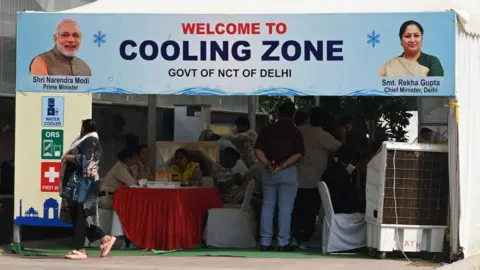
Delhi is also among cities with heat action plans. It includes colour-coded heat alerts, public advisories urging people to avoid peak afternoon exposure, water kiosks and cooling centres.
But much of this advice is difficult to follow in practice. Even when temperatures rise, rent has to be paid and food has to be bought.
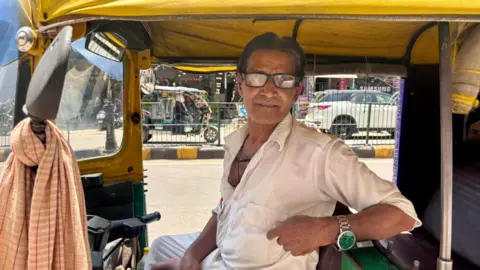
Mohammad Umar, 50, has been sitting inside his tuk-tuk near a busy traffic signal since morning, waiting for passengers.
He says he rarely takes a day off but last week, the heat finally forced him to stay home.
"My heart was racing and my body had no strength left. I must have bathed five times that day just to stay conscious," he says.
But missing work comes with a cost.
"On a single day, I can lose 500-700 rupees (around $5-$7) if I don't work. And we still have to pay for food and daily needs. That money comes out of our small savings," he says.
 Reuters
Doctors say prolonged exposure to extreme heat puts immense strain on the body, especially for people spending long hours outdoors without shade, cooling or adequate hydration.
Dr Satish Koul, principal director and unit head of internal medicine at Fortis Hospital Gurgaon, says hospitals routinely see cases of dehydration, low blood pressure, kidney stress and heat exhaustion during extended heatwaves.
"Early warning signs people often ignore include dizziness, weakness, headache, nausea and confusion," he says.
"If someone stops sweating, becomes disoriented or collapses, it can quickly become a medical emergency."
But for many daily wage workers, escaping the heat is impossible even after work ends.
Much of Delhi's informal migrant workforce lives in densely-packed settlements with unreliable electricity, poor ventilation and no air-conditioning.
Homes here are built from tin sheets and plastic which absorb heat through the day and release it slowly through the night.
Doctors warn that heat-related illnesses become especially dangerous when temperatures remain high overnight, preventing the body from properly recovering.
"When the body does not cool down properly during sleep, exhaustion keeps building day after day," adds Dr Koul.
That exhaustion shapes daily life in these neighbourhoods, where most families depend on physically demanding work to survive.
Men leave early for outdoor jobs, while many women take up low-paying domestic work nearby. Alongside long hours of labour, many women also manage cooking, childcare and household chores in cramped homes with little relief from the heat.
 Hindustan Times via Getty Images
Many try to keep cool by covering their heads, drinking salted water or adjusting work hours to avoid the harshest afternoon sun - but such measures offer only limited relief.
Sanjeeda, a 40-year-old widow who has spent years working in factories, small shops and private homes to raise her children, says in mid-May, she was bedridden for days with severe headaches and fever after heat exposure.
"The sun starts to feel harsh right from the morning," she says. "By the time I reach the houses and start sweeping and mopping, my clothes are already soaked. Some days I also have to clean rooftops where the marble floors feel like they are on fire."
Her employers occasionally offer water, lemonade or a place to sit in front of a fan.
"But no matter what the temperature is," she says, "the work has to be done."