Vikas Pandey and Nikhil InamdarDelhi and Mumbai

 Reuters
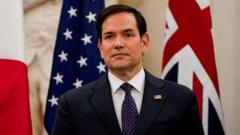
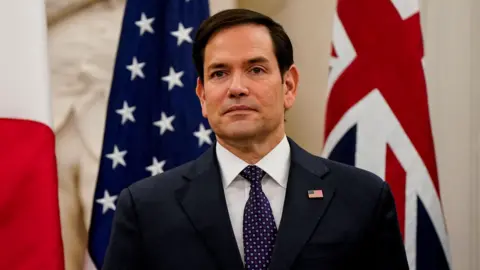
US Secretary of State Marco Rubio arrives in India on Saturday for a four-day visit amid geopolitical crosswinds and a global energy crisis triggered by the Iran war.
Energy shipments through the Strait of Hormuz - a narrow shipping lane that has become a flashpoint since Israel and the US attacked Iran in February - have virtually ground to a halt.
Iran has used the closure of the strait as a pressure tactic in the fragile peace negotiations with the US.
India, which imports more than 80% of its energy needs, is one of the worst affected countries as its vast population of more than 1.4 billion depends on overseas fuel supply, including cooking gas and petroleum products, to sustain daily life.
Rubio has already acknowledged the challenges facing Asia's third largest economy.
"We want to sell them [India] as much energy as they'll buy. And obviously, you've seen, I think, we're at historic levels of US production and US export," he said.
There will be appetite in Delhi to boost its energy imports from the US as it will also help bridge the trade deficit that has been in India's favour - something that has constantly irked President Donald Trump.
The US goods trade deficit with India was $58.2bn in 2025, a 27.1% increase over 2024.
But it's not a straightforward solution. It's a much longer and expensive route for India to get energy shipments from the US.
And analysts say it is not logical for India to fill the current shortfall in its imports from the US.
 Getty Images
"Energy security is going to be the key theme of this visit because the Iran situation is not going to be resolved anytime soon. The US has already given a waiver to India on buying Russian oil, but Delhi is likely to push for more concessions," Vineet Prakash, associate professor of US studies at Delhi's Jawaharlal Nehru University, said.
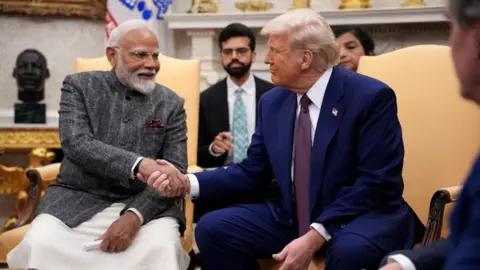
Rubio's visit also comes under the shadow of prolonged tensions between Delhi and Washington over trade negotiations and conflicting claims on who settled the brief India-Pakistan conflict last year.
While Trump has repeatedly claimed that he brokered peace between the neighbours, Delhi has consistently denied it with its stated policy of not welcoming a third party to mediate between the nuclear-armed nations in South Asia.
What also appears to have displeased Delhi is Trump's open affection for Pakistani army chief Asim Munir, whom the US president has called his "favourite field marshal".
Prakash added this wasn't surprising as Pakistan shares a long border with Iran and it's strategically important for the US to keep the country close.
But Rubio is not likely to make statements around Pakistan on this trip.
"Any talks around Pakistan are likely to stay behind closed doors when Rubio meets leaders in Delhi," Prakash added.
 AFP via Getty Images
Meanwhile, the last few months have also seen Washington and Delhi offering an olive branch to each other.
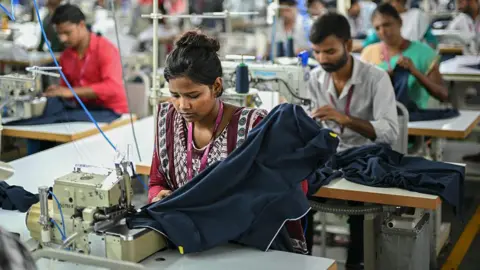
Trump's decision to lower reciprocal tariffs on India earlier this year from 50% to 18% after a 10-month impasse was met with a huge sense of relief in Delhi.
Following a Supreme Court verdict against his sweeping duties, the levies were reduced to 10%, further easing pressure on Indian exporters.
The two sides are currently negotiating the final text of a broader bilateral deal, but further details of the negotiations remain sketchy.
Trade experts, meanwhile, are circumspect about the big numbers being thrown around because India's current trade with the US is at a fraction of the $500bn figure and Trump's announcements haven't been met with tangible investment commitments from India yet.
For instance, Mukesh Ambani, one of India's richest men, has been conspicuously silent on Trump's pronouncement that his company Reliance Industries will back a $300bn oil refinery in Brownsville, Texas - the first in the US in 50 years.
But amid uncertainty around what the final text of the trade agreement with the US will entail, India's exports to the US remained stable at $87.3bn in the year ended March 2026.
"Exports rose 0.9% year-on-year despite steep reciprocal tariffs between May 2025 and February 2026," Ajay Srivastava of the Global Trade and Research Initiative think-tank told the BBC.
And they have continued to rise further as the levies were brought down, with $8.5bn worth of Indian goods shipped to the US in April.
This reflects "continued positive impact of the lowered tariffs", Crisil Research said, adding, though, that "given uncertainties around tariff levels, the trajectory of India's exports to the US remains monitorable".
Amid the uncertainties, India has also been forced to liberalise its notoriously protectionist trade policy. Delhi has expeditiously closed advanced free trade agreements (FTAs) with a range of other countries and blocs, including the UK, European Union, Australia and Oman.
While Trump has said India will lower all tariff and non-tariff barriers on US goods to zero, these deals "provide a framework under which both parties could safeguard some sectors", Pranjul Bhandari of HSBC said after the tariff withdrawal.
This shows that despite a broad opening up of the economy to US companies, sectors like agriculture and dairy could remain fiercely protected even once the final trade deal between India and the US is inked.
Beyond trade, what will be interesting to watch is what public statements the secretary of state makes on India's role in the Iran war.
Rubio knows that India will always be reluctant to play any role beyond diplomacy in keeping the Strait open. Delhi is against Trump's repeated exhortations to other countries to deploy military assets to ensure free shipping in the troubled waterway.
 AFP via Getty Images
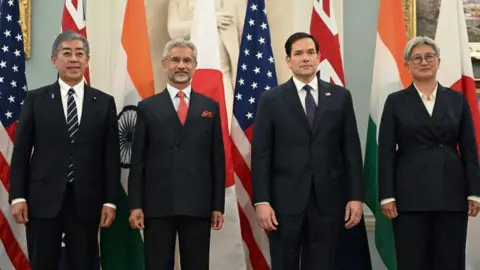
And finally, there is the question of the Quad - a group that also includes Australia and Japan, besides India and the US.
Trump was bullish on the Quad in his first term in office as his administration at the time saw the grouping as a potential challenger to China's dominance in the Indo-Pacific region.
In Delhi, Rubio will attend a meeting of Quad foreign ministers on 26 May, ahead of the expected summit of its leaders later this year in the Indian capital.
So far, there is no confirmation if Trump will attend the summit or whether it will even go ahead.
Prakash says this shows that Trump has realised that "China is not a pushover", and that is why he would want a different kind of engagement around Quad. The summit was due last year, but a lukewarm response from Trump made some say that the Quad was on "life support".
Whether the meeting of Quad foreign ministers can revive the forum will be closely watched.
For Delhi, the leadership summit will be important to further burnish its credentials as a growing geopolitical power, and it will want it to go ahead.
As for the nature of engagement and the tone, Delhi will most likely assess what Rubio has to say on Quad before making any firm statements.
The China factor is as important for Delhi as it's for Washington. And it's particularly crucial now because Delhi is also due to host a summit of Brics - which includes Brazil, Russia, India, China, South Africa, Iran and Saudi Arabia, among others - in September.