Jadzia SamuelSouth East

 Butterfly Conservation/Jim Higham
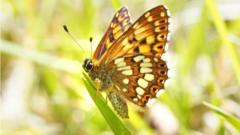
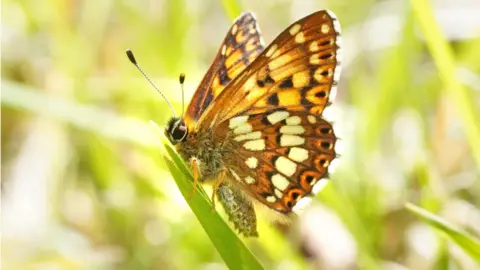
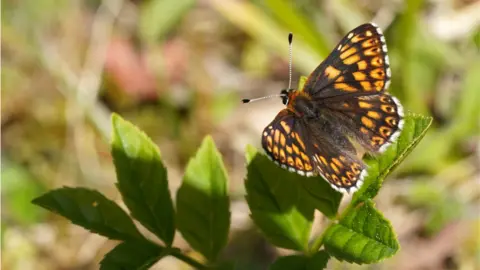
The population of a rare butterfly species has increased by more than 90 times in Kent over two decades, according to a conservation charity.
There were fewer than 50 Duke of Burgundy butterflies in 2005, but this rose to nearly 600 last year, Butterfly Conservation said.
Dr Dan Hore, director of nature recovery at Butterfly Conservation, said this rise is a positive sign for the local environment.
"They're an indicator species," he explained. "Butterflies act as a flagship for smaller insects. When [a population] recovers, it tells you you're getting something right."
Duke of Burgundy caterpillars only eat the leaves of cowslips and primroses, and only when the plants are grown in very specific conditions.
To increase the Kent population, Butterfly Conservation worked with Natural England and farmers to create new habitats.
They encouraged landowners plant food sources on the edge of crop fields or on farmland which did not yield much produce.
Hore said the government's environmental land management schemes (ELM) provided further incentive.
"It's helping the farmer by diversifying their income," Hore said. "It's helping the environment by not putting loads of fertiliser to grow food where it doesn't want to grow."
Similar schemes have been rolled out across England, but Hore said Kent "is the single best example of this working".
 Butterfly Conservation/Jim Higham
Across the UK, the distribution of Duke of Burgundy butterflies has fallen by 89% since 1982, according to Buttery Conservation.
Hore said Kent was one of the few places bucking the trend, with population and distribution now growing.
He described the scheme as a "success story for nature recovery."
When Hore started working with the species in 2003, he said he only recorded three Duke of Burgundy butterflies in the whole of Kent and they only inhabited a single site.
Decades later, there are hundreds of butterflies across dozens of sites.
"Individual species are the building blocks of ecosystems," Hore said. "Those butterflies have a role in pollination."
He added: "For us, this is a really symbolic story. "You can recover even really restricted species if you get the process right."