By
/ CBS News
A new version of SpaceX's mammoth Starship rocket, featuring multiple upgrades, more powerful engines and major safety enhancements is poised for blastoff Thursday in a critical milestone for Elon Musk's rocket company.
It's also a critical mission for NASA, which is counting on SpaceX to develop and deliver a flight-tested, human-rated version of the Starship upper stage to carry Artemis astronauts from lunar orbit to the moon's surface and back before the end of 2028.
With dozens of successful test flights required between now and then, NASA is hedging its bets, working with Jeff Bezos' Blue Origin to develop an alternative lander.
The agency's Artemis III mission late next year will test rendezvous and docking procedures in low-Earth orbit using one or both landers, depending on their readiness. NASA wants to test those procedures close to home before pressing ahead with a moon landing in the Artemis IV mission.
But first, SpaceX must perfect the Super Heavy-Starship launch system after 11 test flights marked by impressive successes and spectacular failures. The company says the debut of the "version 3" Starship this week will open a new chapter in the rocket's development.
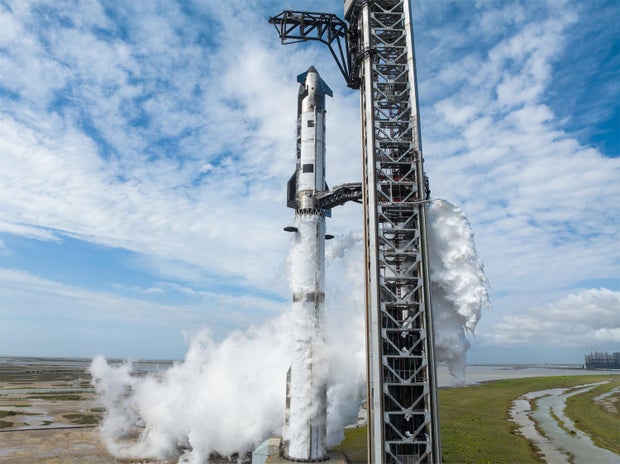
Using a new, beefed-up pad at SpaceX's "Starbase" launch site on the Texas Gulf coast, the 12th integrated test flight of a Super Heavy-Starship rocket is set for blastoff at 6:30 p.m. ET Thursday, weather permitting. High winds and rain were blamed for two launch delays earlier this week.
Whenever the mission gets off, it will mark the first flight of the version 3 rocket with all its upgrades and the first use of the company's second Texas launch pad.
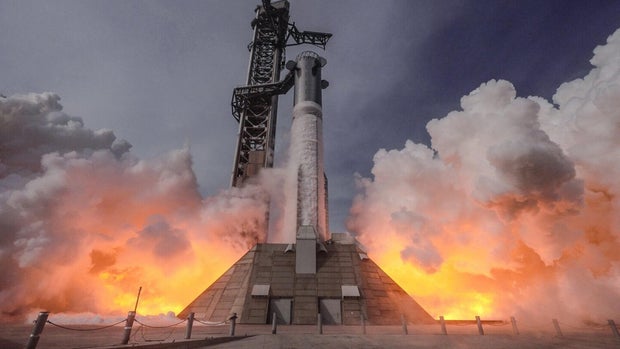
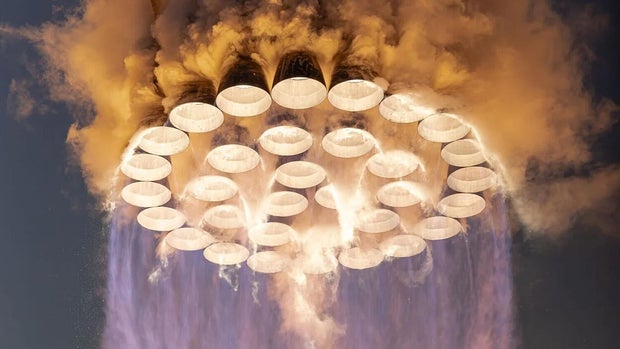
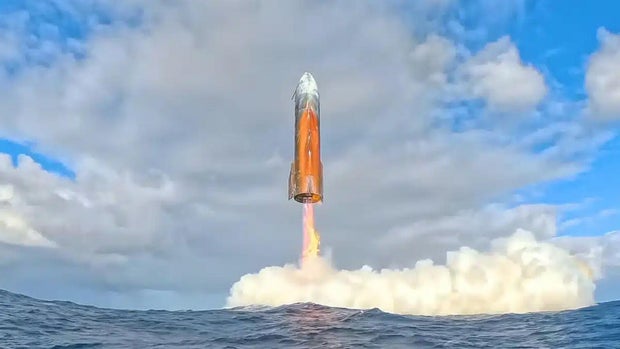
As with previous test flights, the Super Heavy's 33 methane-fueled Raptor engines, lighter but more powerful than earlier versions, will propel the Starship upper stage out of Earth's lower atmosphere. The first stage will then separate and fly itself back to a controlled splashdown off the Texas Gulf coast.
Because it is the maiden flight of a version 3 booster, SpaceX opted for a Gulf splashdown instead of a launch pad catch by the gantry's iconic "chopstick" mechanical arms.
"The booster's primary test objective will be executing a successful launch, ascent, stage separation, boostback burn and landing burn at an offshore landing point in the Gulf of America," SpaceX said on its website. "As this is the first flight test of a significantly redesigned vehicle, the booster will not attempt a return to the launch site for catch."
After the booster's departure, the Starship upper stage will use its own set of Raptors to climb to a sub-orbital trajectory, looping halfway around the planet before re-entry and a Raptor-powered descent to splashdown in the Indian Ocean about an hour and five minutes after liftoff.
"The Starship upper stage will target multiple in-space and reentry objectives, including the deployment of 22 Starlink (satellite) simulators," SpaceX said. "The last two satellites deployed will scan Starship's heat shield and transmit imagery down to operators to test methods of analyzing Starship's heat shield readiness for return to launch site on future missions."
In addition, the planned re-entry trajectory will "intentionally stress" the Starship's rear flight control flaps and the spacecraft will carry out a "dynamic banking maneuver "to mimic the trajectory that future missions returning to Starbase will fly," the company said.
Some 50 on-board cameras will document the flight, sending imagery back to Earth via Musk's Starlink satellite system.
SpaceX has had mixed results with the previous 11 Super Heavy-Starship flights, but the company applies lessons learned to each succeeding launch, and many of those lessons are built into the version 3 spacecraft.
"The flight test's primary goal will be to demonstrate each of these new pieces in the flight environment for the first time, with each element of the Starship architecture featuring significant redesigns to enable full and rapid reuse that incorporate learnings from years of development and test," SpaceX said on its website.
The Super Heavy-Starship, known collectively as just Starship, is the largest, most powerful rocket ever built. Version 3 is capable of up to 18 million pounds of liftoff thrust, roughly twice the power of NASA's Space Launch System moon rocket.
SpaceX plans to use the Starship system to launch Starlinks and other satellites into Earth orbit, to deploy science probes, to serve as a NASA moon lander and, eventually, to carry astronauts to Mars.
While Earth-orbit missions appear to be relatively straightforward, using Starship landers in NASA's Artemis program poses severe technical challenges. Many outside observers doubt the Starship will be ready in time for NASA's planned 2028 moon landing.
Given SpaceX's track record and success building reusable Falcon 9 boosters with landings at sea and on shore, others give the company the benefit of the doubt. Still, using a Starship variant as a moon lander is an especially complex undertaking.
Because the Starship uses most of is propellants just getting into Earth orbit, the lander must be refueled before it heads to the moon. Multiple Super Heavy-Starship tanker flights — the exactly number is not yet known — will be needed to autonomously refuel the lander in Earth orbit before it can head for deep space.
Russian Progress cargo ships routinely carry fuel to the International Space Station, but repeatedly transferring thousands of gallons of cryogenic propellants from one vehicle to another on a relatively tight schedule has never been attempted in space.
And SpaceX has not yet revealed how it plans to minimize the amount of supercold propellants that will naturally "boil off" in space, turning into gas that must be vented overboard.
All of that still leaves the challenge of safely landing on the moon.
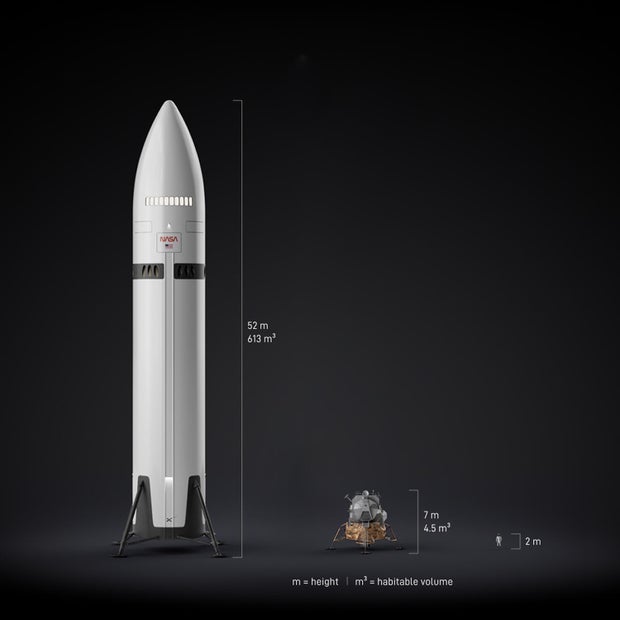
To do so, Artemis astronauts in an Orion capsule will have to dock with the Starship in lunar orbit, float inside, undock and descend to a fully automated landing near the moon's south pole, setting a 170-foot-tall rocket down on uncertain terrain amid long shadows and poor lighting.
Once safely down, the astronauts will descend to the surface on an external elevator that will deploy from the side of the rocket. After the surface mission is complete, they will ride the elevator back to the crew cabin at the top of the Starship and blast off to rendezvous with the Orion capsule for the trip back to Earth.
SpaceX's contract with NASA requires one unpiloted moon landing mission before the agency will consider putting astronauts aboard.
But future challenges aside, the latest version of the Super Heavy-Starship is a major step in SpaceX's drive to develop a rocket Musk says will one day carry men and women to the moon and on to Mars.
In: