By

Jacob Wycoff
Jacob Wycoff is a meteorologist at WBZ-TV and will contribute to weekend morning newscasts. Jacob is a member of the National Weather Association and the American Meteorological Society.
/ CBS Boston
A meteor exploded off the coast of Massachusetts, causing a loud boom to be heard throughout the state Saturday afternoon, according to WBZ-TV chief meteorologist Eric Fisher.
It was heard around 2:11 p.m. Eastern Time, with people describing a sudden bang that rattled windows, startled pets, and even shook some homes. Dozens of phone calls came into the WBZ-TV newsroom reporting a loud explosion heard around Boston, as far as Ipswich and Johnston, Rhode Island.
According to preliminary reports submitted to the American Meteor Society, dozens of people across the Northeast reported seeing the fireball around 2 p.m. Saturday. Sightings stretched across multiple states, helping scientists piece together the meteor's path through the atmosphere.
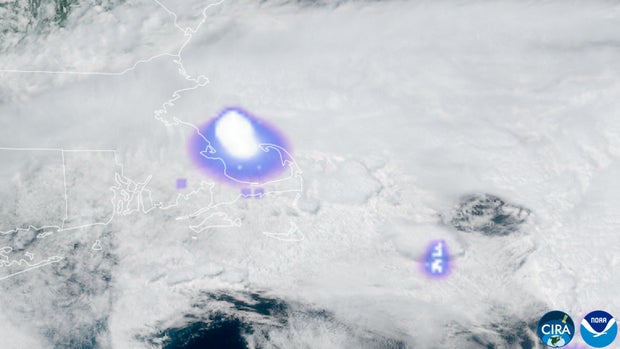
Satellite lightning data from the National Oceanic and Atmospheric Administration showed a signature consistent with a meteor around the same time the boom was reported. The data also showed that the meteor probably entered the atmosphere over the South Shore near Boston. There are no reports of where the meteor landed.
Most meteors burn up harmlessly in the atmosphere, but larger objects can occasionally survive long enough to create the brilliant fireballs and booming shock waves that grab people's attention.
Why would a meteor cause a sonic boom?
If you heard the boom Saturday afternoon, you may be wondering how a space rock can make that much noise.
Meteors enter Earth's atmosphere at incredible speeds, often traveling between 25,000 and 160,000 miles per hour. Most are no larger than pebbles or grains of sand and burn up harmlessly high above our heads.
Occasionally, a larger object survives long enough to plunge deeper into the atmosphere. As it tears through the air, it creates powerful shock waves, much like a supersonic jet. Those pressure waves can travel all the way to the ground as a sonic boom, sometimes heard dozens of miles from the meteor's actual path.
That's why some people may have heard a loud bang even if they never saw the fireball itself.
Other meteors in 2026
Saturday's event is the latest in a string of high-profile fireballs reported across North America this year. In March, a meteor exploded over Ohio, producing a sonic boom heard across multiple states
Just days later, another fireball over Texas generated a powerful shock wave and scattered meteorites across the Houston area, including one fragment that reportedly crashed through the roof of a home. Scientists with the American Meteor Society have also documented an unusual increase in large fireball events and sonic booms during the first months of 2026.
The Massachusetts boom also comes just a day after residents across South Carolina reported a mysterious blast that many initially mistook for an earthquake. The U.S. Geological Survey later determined that event was consistent with a sonic boom, although the exact source remains under investigation.
Researchers stress that there is no evidence of an impact threat to Earth.
In: